
Arts, Sciences, and the Futures of Intelligence
Conference | October 23 & 24, 2025
Arts Festival | October 19 – 25, 2025
University of Toronto
N.B.: While tickets for all sessions are sold out, additional seats will be provided on the day on a first-come-first-serve basis
You can also join us over Zoom:
Link for all sessions: https://utoronto.zoom.us/j/82603012955
Webinar ID: 826 0301 2955
Passcode: 512183
2025 marks an inflection point in our technological landscape, driven by seismic shifts in AI innovation.
Who’s Afraid of AI? Arts, Science, and the Futures of Intelligence is a week-long inquiry into the implications and future directions of AI for our creative and collective imaginings, and the many possible futures of intelligence. The complexity of these immediate future calls for interdisciplinary dialogue, bringing together artists, AI researchers, and humanities scholars.
In this volatile domain, the question of who envisions our futures is vital. Artists explore with complexity and humanity, while the humanities reveal the histories of intelligence and the often-overlooked ways knowledge and decision-making have been shaped. By placing these voices in dialogue with AI researchers and technologists, Who’s Afraid of AI? examines the social dimensions of technology, questions tech solutionism from a social-impact perspective, and challenges profit-driven AI with innovation guided by public values.
The two-day conference at the University of Toronto’s University College anchors the week and features panels and debates with leading figures in these disciplines, including a keynote by 2025 Nobel Laureate in Physics Geoffrey Hinton, the “Godfather of AI” and 2025 Neil Graham Lecturer in Science, Fei-Fei Li, an AI pioneer.
Throughout the week, the conversation continues across the city with:
- AI-themed and AI powered art shows and exhibitions
- Film screenings
- Innovative theatre
- Experimental music
Who’s Afraid of AI? demonstrates that Toronto has not only shaped the history of AI but continues to prepare its future. Step into this changing landscape and be part of this transformative dialogue — register today!
Organizing Committee:
Pia Kleber, Professor-Emerita, Comparative Literature, and Drama, U of T
Dirk Bernhardt-Walther, Department of Psychology, Program Director, Cognitive Science, U of T
David Rokeby, Director, BMO Lab, Centre for Drama, Theatre and Performance Studies, U of T
Rayyan Dabbous, PhD candidate, Centre for Comparative Literature, U of T
Two-Day Conference Program
The conference will explore core questions about AI such as its capabilities, possibilities and challenges, bringing their unique research, creative practice, scholarship and experience to the discussion. Speakers will also engage in an interdisciplinary conversation on topics including AI’s implications for theories of mind and embodiment, its influence on creation, innovation, and discovery, its recognition of diverse perspectives, and its transformation of artistic, cultural, political and everyday practices.
Thursday, October 23, 2025
Mind the World
9 AM | Clark Reading Room, University College – 15 King’s College Circle
What are the merits and limits of artificial intelligence within the larger debate on embodiment? This session brings together an artist who has given AI a physical dimension, a neuroscientist who reckons with the biological neural networks inspiring AI, and a humanist knowledgeable of the longer history in which the human has tried to decouple itself from its bodily needs and wants.

Suzanne Kite
Director, The Wihanble S’a Center for Indigenous AI

James DiCarlo
Director, MIT Quest for Intelligence

N. Katherine Hayles
James B. Duke Distinguished Professor Emerita of Literature
Staging AI
11 AM | Clark Reading Room, University College – 15 King’s College Circle
How is AI changing the arts? To answer this question, we bring together theatre directors and artists who have made AI the main driving plot of their stories and those who opted to keep technology secondary in their productions.

Kay Voges
Artistic Director, Schauspiel Köln

Roland Schimmelpfennig
Playwright and Director, Berlin

Hito Steyerl
Artist, Filmmaker and Writer, Berlin
Recognizing ‘Noise’
2 PM | Clark Reading Room, University College – 15 King’s College Circle
How can we design a more inclusive AI? This session brings together an artist who has worked with AI and has been sensitive to groups who may be excluded by its practice, an inclusive design scholar who has grappled with AI’s potential for personalized accessibility, and a humanist who understands the longer history on pattern and recognition from which emerged AI.

Marco Donnarumma
Artist, Inventor, Theorist, Berlin

Jutta Treviranus
Director, OCADU,
Inclusive Design Research Centre

Eryk Salvaggio
Media Artist and Tech Policy Press Fellow, Rochester
Art, Design, and Application are the Solution to AI’s Charlie Chaplain Problem
4 PM | Hart House Theatre – 7 Hart House Circle

Daniel Wigdor
CoFounder and Chief Executive Officer, AXL
Keynote and Neil Graham Lecture in Science
4:00 PM | Hart House Theatre – 7 Hart House Circle

Fei-Fei Li
Sequoia Professor in Computer Science, Stanford Institute for Human-Centered AI

Geoffrey Hinton
2024 Nobel Laureate in Physics, Professor Emeritus in Computer Science
Friday, October 24, 2025
Life with AI
9 AM | Clark Reading Room, University College – 15 King’s College Circle
How do machine minds relate to human minds? What can we learn from one about the other? In this session we interrogate the impact of AI on our understanding of human knowledge and tool-making, from the perspective of philosophy, computer science, as well as the arts.

Jeanette Winterson
Author, Fellow of the Royal Society of Literature, Great Britain

Leif Weatherby
Professor of German and Director of Digital Theory Lab at
New York University

Jennifer Nagel
Professor, Philosophy, University of Toronto Mississauga
Discovery & In/Sight
11 AM | Clark Reading Room, University College – 15 King’s College Circle
This session explores creative practice through the lens of innovation and cultural/scientific advancement. An artist who creates with critical inspiration from AI joins forces with an innovation scholar who investigates the effects of AI on our decision making, as well as a philosopher of science who understands scientific discovery and inference as well as their limits.

Vladan Joler
Visual Artist and Professor of
New Media, University of Novi Sad

Alán Aspuru-Guzik
Professor of Chemistry and Computer Science, University of Toronto

Brian Baigrie
Professor, Institute for the History and Philosophy of Science & Technology, University of Toronto
Social history & Possible Futures
2 PM | Clark Reading Room, University College – 15 King’s College Circle
How does AI ownership and its private uses coexist within a framework of public good? It brings together an artist who has created AI tools to be used by others, an AI ethics researcher who has turned algorithmic bias into collective insight, and a philosopher who understands the connection between AI and the longer history of automation and work from which AI emerged.

Memo Akten
Artist working with Code, Data and AI, UC San Diego

Beth Coleman
Professor, Institute of Communication, Culture, Information and Technology, University of Toronto

Matteo Pasquinelli
Professor, Philosophy and Cultural Heritage Università Ca’ Foscari Venezia
A Theory of Latent Spaces | Conclusion: Where do we go from here?
4 PM | Clark Reading Room, University College – 15 King’s College Circle
Antonio Somaini, curator of the remarkable ‘World through AI’ exhibition at the Museé du Jeu de Paume in Paris, will discuss the way in which ‘latent spaces’, a core characteristic of current AI models as “meta-archives” that shape profoundly our relation with the past.
Following this, we will engage in a larger discussion amongst the various conference speakers and attendees on how we can, as artists, humanities scholars, scientists and the general public, collectively imagine and cultivate a future where AI serves the public good and enhances our individual and collective lives.”

Antonio Somaini
Curator and Professor, Sorbonne Nouvelle
Arts Events

October 22 | 8 – 10 PM | Marco Donnarumma, preview of Lestes, a new performance installation | Paul Cadario Conference Room, University College – 15 King’s College Circle

October 22 | 8 – 10 PM | Memo Akten and Katie Hofstadter, SUPERRADIANCE, AI generated projection based on human movement | BMO Lab, University College – 15 King’s College Circle, room H-12
October 23 | 2 PM | Jeanette Winterson: Arts & AI Talk | Paul Cadario Conference Room, University College – 15 King’s College Circle

October 24 | 7 PM | The Kiss by Roland Schimmelpfennig, a reading with tech, performed by Maev Beaty and Eve Egoyan, directed by Brendan Healy | The BMO Lab, University College – 15 King’s College Circle.
(Note: we are scheduling more performances. Check back for more info soon!)



October 25 | 8 PM | AI Cabaret featuring Jason Sherman, R. H. Thompson, Sarah Orenstein, Rick Miller, Cole Lewis, BMO Lab projects and more | Crow’s Theatre, Nada Ristich Studio-Gallery – 345 Carlaw Avenue
(Use promo code AICAB for 100% discount)
Student Competition
October 22 | 2 PM | Student Forum and AI Commentary Contest Award | Paul Cadario Conference Room, University College – 15 King’s College Circle
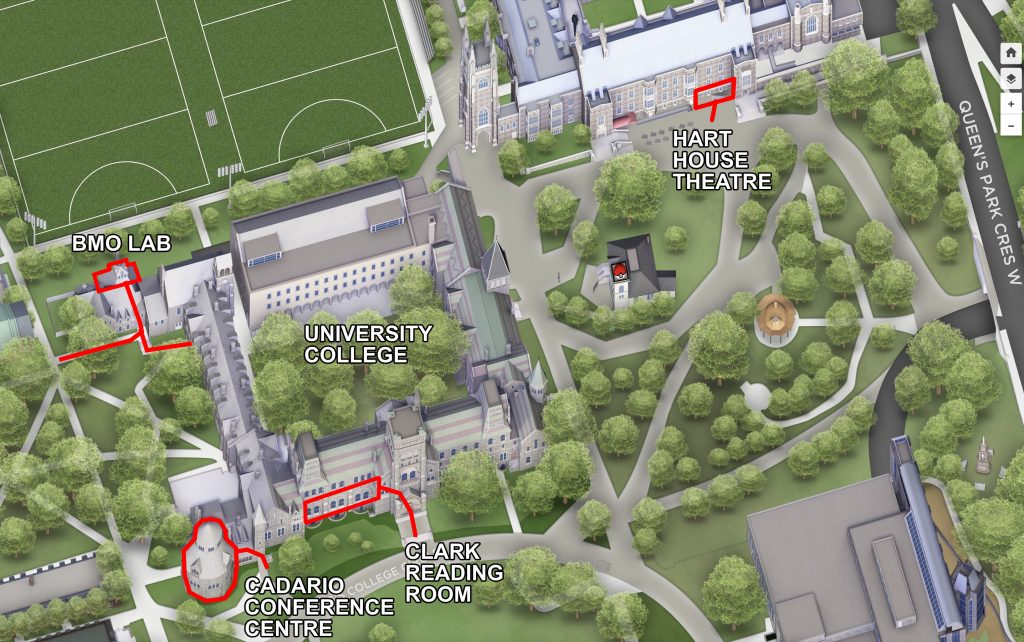
Map of Conference Locations
University of Toronto, University College & BMO Lab would like to thank the following co-sponsors: TUX (tux-hci.org), SSHRC, Jackman Humanities Institute, CIFAR, Hart House, Department of Psychology, Temerty Centre for AI Research and Education in Medicine, Centre for Comparative Literature, Schwartz Reisman Institute for Technology and Society, Department of Philosophy, Faculty of Information, Hart House Theatre, Department of Computer Science, ICCIT, Department of English, Department of Germanic Languages & Literatures, Institute for the History & Philosophy of Science & Technology.