Events will take place at the new location of BMO Lab:
BMO Lab
Room 227,
Centre for Drama, Theatre and Performance Studies,
University College,
15 King’s College Circle
Directions to BMO Lab
September 30, 4.30-6pm
Fabian Offert, University of California – Santa Barbara
Of All Virtues Only One: Theater after Artificial Intelligence
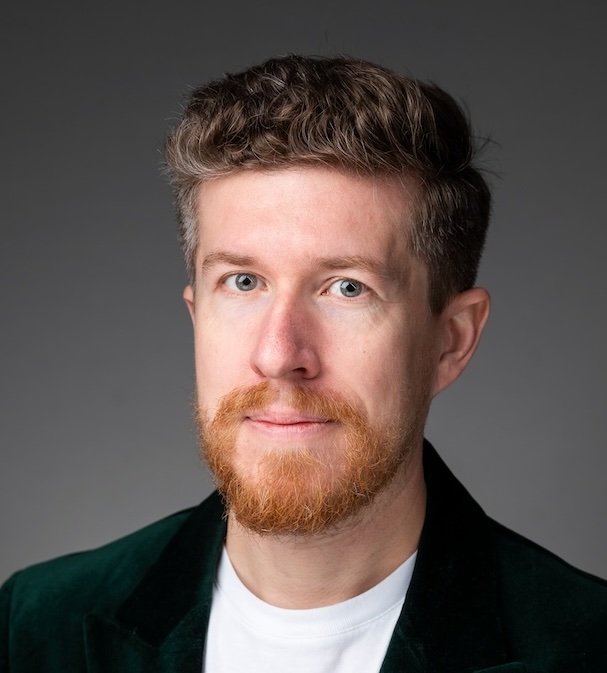
Fabian Offert is Assistant Professor for the History and Theory of the Digital Humanities and Co-Director of the Center for the Humanities and Machine Learning (HUML) at the University of California, Santa Barbara. His research and teaching focuses on the epistemology, aesthetics, and politics of artificial intelligence. His most recent book, Vector Media (Meson Press/University of Minnesota Press, 2026) writes the first comprehensive history and theory of vector space as a space of universal commensurability in contemporary machine learning. Fabian was 2025 Rudolf Wittkower Fellow at the Bibliotheca Hertziana – Max Planck Institute for Art History in Rome and will be Visiting Professor at the University of Marburg’s Center for Digital Culture and Infrastructure in 2026. https://zentralwerkstatt.org/
October 6, 4.30-6pm
Elizabeth Hunter, Washington University, St. Louis
VISIBLE 1.0: Resurrecting a Nineteenth-century Moving Panorama with Mobile AR and GenAI

Elizabeth Hunter is Assistant Professor in Drama, Director of Graduate Studies, and Director of the Fabula(b) Theatre + New Media Lab in the Performing Arts Department at WashU. Her first monograph, Acting the Part: Audience Participation in Performance (University of Michigan Press 2025), offers a new paradigm for understanding how audiences participate in immersive theatre, from physical spaces like the Globe in London to digital spaces like social virtual reality. She is currently working on her next book project, which mounts the first scholarly analysis of digital resurrection—the use of AI and spatial computing to bring back the dead—as performance. Titled, “Death Is Obsolete: Staging Resurrection in the Age of AI,” this project explores how a critical lens of performance theory can illuminate the user roles and production choices inherent in digitally resurrecting all manner of bodies, from the corporeal to the architectural. The theoretical side of Professor Hunter’s research complements her practice-led work as the Director of Fabula(b), where she leads an interdisciplinary team to create digital adaptations of canonical dramas and other famous stories as a mode of historiographic and dramaturgical analysis. The lab’s current project, “VISIBLE: Resurrecting Henry ‘Box’ Brown’s Moving Panorama, ‘Mirror of Slavery,’” is currently in prototyping. https://sites.wustl.edu/fabulab/
October 14, 4.30-6pm
Kenneth Collins, Temporary Distortion and the University of Utah
Silicon and Carbon: Computational Chamber Theatre

Kenneth Collins works in the gray space between the “black box” of theatre and the “white cube” of the art gallery, creating projects at the intersection of visual art, digital media, theatre, cinema, and artificial intelligence, investigating questions of authorship, embodiment, and human expression in the age of generative media. His practice encompasses sculpture, video art, installation, performance, and synthetic media works that challenge the traditional boundaries between disciplines. He is the founder and artistic director of Temporary Distortion (2000-present), named one of the “Best New York Theater Companies” by TimeOut NY Magazine, and his work as a visual artist has been exhibited internationally. Collins currently serves as an Assistant Professor in the Department of Film and Media Arts at the University of Utah, where he is a Responsible AI Initiative (RAI) Faculty Fellow and holds a shared-faculty appointment with the Scientific Computing and Imaging (SCI) Institute. In Fall 2023, Collins became the first professor at a major university to develop and teach a dedicated course in AI Filmmaking. https://www.temporarydistortion.com/
October 21, 11am-1pm ***note change in time
Liz Santoro and Pierre Godard, Le Principe d’Incertitude
Artists’ Talk & Presentation

American choreographer and dancer trained at the Boston Ballet School, Liz Santoro studied neuroscience at Harvard University before embarking on a career as a performer for a number of experimental dance artists in New York. This path led her to a somatic research on the “performative body,” which remains the main driving force behind her own creation projects and collaborations with LPDi.Since the creation of their company Le principe d’incertitude (LPDi) in 2011, Liz Santoro and Pierre Godard have been collaborating closely together to build choreographic machines that try to thwart the habits of our attention. The singularity of their respective paths has led them to develop systems of creation centered on movement and text which, by revealing their underlying processes – mechanisms of power and seduction, organization of the social space, operating modes of the nervous system – offer the spectator an experience of a perceptual interaction where looking becomes an action that provokes a reaction. Their work has been presented in France, Europe, North America and Asia. They have created various group pieces, We Do Our Best (2012), Relative Collider (2014), For Claude Shannon(2016), Maps (2017), Noisy Channels (2018, 2019), Stereo (2019) as well as in situ pieces such as Watch It (2012), Quarte (2014), FCS Redux (2017, 2018), Mass over Volume (2017) andLearning (2018, 2019). Watch It received a Bessie Award in 2013 in the category “Outstanding Production for a work at the forefront of contemporary dance.” Pierre and Liz were the associated artists at the CDCN / Atelier de Paris from 2016 to 2018. www.ldpi.org
If you have any questions, please feel free to reach out or to consult information on the BMO Lab website. We look forward to seeing you in the Lab this fall!
Leave a Reply